Monday, August 3, 2015

Pro Tour Origins Aftermath Part 1: Brewing R/u

I wanted to do a short recap on what decks we tested for the Pro Tour that didn't make the cut and why, and discuss why the deck we chose was wrong, but in the future could be right.  I'm not going to be able to do that in one post - this will probably end up as a three part series.  I will be focusing on constructed for this portion and limited in the next.

My team ended up with everyone from our team making Day 2, which I think is a huge accomplishment.

Early in testing we started by running a whole bunch of brews against our gauntlet.  Most brews (including our own U/R Ensoul deck) got demolished by the gauntlet and were ruled out for the Pro Tour.  There were two decks that seemed to perform very well - the deck we ended up choosing (Mardu Dragons) and this one:

Here's my brew which I was championing throughout testing, which I want to talk about in depth.

4 Monastery Swiftspear
4 Abbot of Keral Keep
1 Chandra, Pyromaster

4 Wild Slash
2 Searing Blood
4 Lightning Strike
3 Stoke the Flames
4 Exquisite Firecraft
4 Magmatic Insight
4 Treasure Cruise
2 Anger of the Gods
4 Shivan Reef
4 Temple of Epiphany
2 Swiftwater Cliffs
2 Mana Confluence
10 Mountain
2 Island

Sideboard:

2 Anger of the Gods
1 Keranos, God of Storms
1 Outpost Seige
2 Searing Blood
4 Disdainful Stroke
2 Negate
1 Disperse
2 Psychic Rebuttal

The concept was that this deck could just be burn G1 and transform into whatever it needed to be. The sideboard was never quite finalized, so there is a lot of room to improve there (Smash to Smithereens against Thopters for example).

This is much more of an all-in prowess deck than anything else - the reason we want Magmatic Insight is to trigger Prowess for one mana and set up Treasure Cruise for one mana, all so we can cast 3-4 spells in a turn to set up a lethal attack. Abbot is almost always a T3 play where we are trying to hit a free land, but is live to hit a free Magmatic Insight, Cruise (if our yard is stocked), Wild Slash, or Swiftspear.

Maindeck Anger of the Gods looks weird in a deck with creatures, but it actually is very easy to cast it as the second spell of the turn to both keep and pump our Swiftspears. This deck can steal a lot of wins by for example T5 playing Searing Blood + Anger to get rid of multiple Deathmists/Den Protectors and a Seige Rhino, then attacking for 8.

Our matchups look like this: (pre-Pro Tour lists)

Other Red Decks

60/40 at worst G1. G2/3s are closer to 80/20. Goblins is just a bye. This is why you should play this deck.  We are playing a main deck with so many answers (even maindeck Anger) that they can't easily keep up. Post-board they really don't have great options other than hope to draw Eidolon. We slow down a bit with more Angers and Psychic Rebuttal. They generally win by drawing 15+ points of burn. We win by killing the first two or three creatures.

U/B control, Esper Dragons, Thopter Control

70/30 at worst. We are just a creatureless burn deck in these matchups. Comes down to how many counters they have and how many draw spells we draw. We have Disdainful Stroke post-board to counter Digs which often catches them off guard.  Foul-Tongue Invocation is sometimes a problem, but most decks are not running it any more (expect that to change though!).

Green Devotion

30/70 at best G1. 40/60 at best G2/3. This is our worst matchup. Our burn spells don't double as removal most of the time, so we are stuck either making poor trades or directing all of our cards at their face and racing. Some games are won by bolting an Elvish Mystic and winning the race, others by just them drawing poorly. They should be winning the others though. Post-board we bring in Disdainful Strokes which are huge, but we can't always have them in time.

Abzan Rally

Not sure. We didn't end up testing this matchup since this deck had been scrapped before Rally became big. I believe it will be in our favor, because their little dudes don't really do anything against us. We don't have any way to stop the combo though, so they have the potential to nut-draw us. Bringing in Disdainful Strokes seems good.


U/R Ensoul Artifact

I would guess that this matchup isn't too bad, but beating Ensoul is very hard. We can modify the sideboard to beat this matchup though, by adding copies of Smash to Smithereens and Disperse. Negate is very, very strong in this matchup in my opinion because it counters both Ensoul and Shrapnel Blast, which are the only cards we are very afraid of.

Saturday, April 19, 2014

Building around Atheros: B/W Midrange with JOU and How to Build a Midrange Deck

Hey, its been a while!  I'm mostly writing again because there have been a series of very popular posts on various magic subreddits talking about B/W... all of which involved significant amounts of bad information, horrible lists, and upvoted bad explanations.  I'm just gonna step in and talk about B/W for a bit and try to whittle away a bit of the ignorance :)

Let us start from the bottom here:  Do we want to be Aggro, Midrange, or Control?

I'm going to be very hyperbolic for a second and claim that B/W control in this format is ALWAYS going to be a bad Esper control.  So i'm not even going to discuss that - it is a completely different deck, and is much easier to build.  So let's figure out how aggressive we want to be.

Right now in Standard our Gauntlet is something like this: (numbers from MTGgoldfish)


This is obviously going to change very quickly with the new set, but it is a solid stepping stone to get us to the right metagame.  The main changes I can see are U Devotion getting a little worse due to the printing of Deicide and Esper getting a little better for the same reason.  R/G/x Monsters is seeing a disproportionately low amount of play for how good its results are, so people will likely return to it.

Against decks like R/G and U Devotion, I definitely want to be a little bit more aggressive.  R/G has a slew of card advantage tools that can put the game out of reach quickly for us, and the more pressure they have on them, the worse their cards are.  U Devotion has Thassa and her Bident to finish games against slower decks, and often the best way to combat this is to just be faster with a few disruption spells.

For the rest of the format, namely Mono-B, Esper, and Burn, I really want to be a Midrange deck jam-packed with hard to answer threats, hand disruption, and efficient removal.

So our plan is going to be this:  For game 1, we target the higher % of the meta and stick with a Midrange strategy.  For Games 2 and 3, if we can find enough amazing cards against G/R and U, we stick with our game 1 plan.  Otherwise, we will side into a more aggressive deck.

So now that we know we want to be a bit slower, lets start our list with the obvious:

4 Thoughtseize

There is no way to justify not playing 4 of this card unless you truly don't care what your opponent is doing.  Even then, the information it provides is often worth more than the card it takes.  For B/W we are incredibly dependent on this card because we need to find a plan of attack in every game that the opponent simply cannot answer - this will craft that opening.

5-10 Removal Spells

This is metagame dependent, but right now I think we want more because we get so many high-utility removal spells which are never dead.  I think this is how we want to arrange them:

3 Hero's Downfall
2 Banishing Light
2 Ultimate Price
2 Deicide

Honestly, this is incredibly likely to be just wrong as the metagame shifts.  But it will be useful to take this moment to discuss Banishing Light.   This card is good.  It hits everything.  Unfortunately, now that there are so many great enchantments in the format, Banishing Light included, enchantment removal is not just main deckable, but easily 4 slots main for most decks.  Banishing Light can only be considered a temporary answer because of this.  That said, it is still good enough that we should be running it to hit the really hard-to-kill threats like Chandra's Phoenix.

Let's just estimate that we want 25 lands right now, which will leave us with 22 creatures.  Let's start with the easy includes:

4 Soldier of the Pantheon
4 Desecration Demon
4 Obzedat, Ghost Council

This mostly comes down to the absolute most basic here - we need to actually win the game.  These are the cards that will most consistently do that on their own.  One of the most important aspects of the most successful midrange decks in the past is that they all have had multiple very hard to answer threats with enough power to close games quickly.  I'm going to create some handy charts to compare some threats to explain this better - so let's get started:


Soldier of the Pantheon


Soldier is simply the best one-drop in Standard right now.  He hits hard, is hard to block, comes down early, and blocks a lot of the largest threats without dying.  While he certainly is lacking in the utility department, his power is above average and we are getting way more than we pay for.  There is no way I'm running less than 4.

Desecration Demon


Desecration Demon is, in my opinion, one of the most overplayed cards in Standard.  I find it to be very win-more in most situations, and very one-dimensional.  But when you need a four mana creature that hits like a freight train, this is a pretty good place to be.  Alms Beast is certainly a consideration, but I think that flying is very important right now.

Obzedat, Ghost Council


This is the reason we are able to even play this deck.  This card is stupid powerful.  If Desecration Demon is a freight train, this is a tactical nuke.  Extra utility comes from the life gain and protecting itself from sorcery speed removal.

What I'm really trying to illustrate here is that the threats we want to play are efficient, big, and hard to deal with.  Once those are in place, we can fill in the gaps with more utility creatures.

The last 10 slots are basically flex slots which should be adapted to the metagame.  In my opinion they should look about like this:

4 Cartel Aristocrat
4 Brimaz, King of Oreskos or Master of the Feast
2 Atheros, God of Passage

 Master of the Feast is just another freight train, and I think it is a bit worse than our other threats, but it really comes down to how much removal is going to be played.  It is going to be very good against R/G, but very weak against Mono-B.  If the metagame isn't in that spot, then Brimaz is the man to go to: He can come down after a Wrath and win the game on his own, or shut down an opposing aggro deck by himself.

Cartel Aristocrat is really... not that good here.  But we really want a two that can provide some utility and I feel like providing a bit of inevitability is great.  Our other choices for this slot are Brain Maggot (which just doesn't attack well enough for my liking right now) and Underworld Coinsmith, which is solid, but I feel will be worse in most matchups.

Atheros is kind of questionable here - his ability is very mediocre and without Obzedat, he will rarely turn on.  That said, the matchups where he does turn on - R/G, the mirror, sometimes control - he is going to be a powerhouse.  I want to play this card, but I don't really want to play more than 2 main.

There is also one more card which might deserve a place: Elspeth, Sun's Champion.  I think Elspeth is a little slower than what we want right now, but she is going to be extremely important in the mirror.


For reference, here is the list I am going to start off the format playing:

4 Soldier of the Pantheon
4 Cartel Aristocrat
4 Brimaz, King of Oreskos
4 Desecration Demon
4 Obzedat, Ghost Council
2 Atheros, God of Passage

4 Thoughtseize
3 Hero's Downfall
2 Banishing Light
2 Ultimate Price
2 Deicide
4 Godless Shrine
4 Temple of Silence
4 Mana Confluence
7 Plains
6 Swamp

Let me know what you think!  Thanks for reading.


Wednesday, December 25, 2013

The Best Music of 2013

It feels like it is always too soon to write end of the year posts.  In writing a summary there is a sort of feeling of completion - that there is nothing left to add - and man, there is some kind of crazy subconscious force in me which wants that to never happen.  Tomorrow is Christmas Eve, the week after is my house's fabled New Years party, and in between is a potentially infinite supply of experiences we can get lost in.  I hope my musical experiences can serve as a catalyst in that regard - unlocking old memories, making new connections, and exposing feelings thought forgotten.

If you missed absolutely any of these songs, now is your chance!

Mapei - Don't Wait
Genres Soul, World, Hip-Hop, Pop, Electronic, Female Vocal 
Listen to this if you are missing someone you love and need cheering up.

The addictive qualities here are just countless - the amazing vocal layering, the unnatural chord progressions, the sheer oddity of the song structure.  Mapei has serious potential, and is a natural choice to become huge in the near future.  Interestingly enough, Mapei's only wikipedia entry is on the Swedish wikipedia, but we all speak Swedish already right?


Genres Post-Dubstep, Minimal, Soul, Vocal
Listen to this if you are riding the train home at night through the snow, looking out the window, reminiscing about life.

James Blake is the apparent community appointed leader of the "post-dubstep" genre, fusing classic R&B samples, powerful synths, minimal beats, and tons of layering.  Think something like Burial producing Imogen Heap, sampling Boyz 2 Men.  This song kind of just has everything going for it - the catchiest vocal melody ever, a huge synth buildup to an epic climax, haunting falsetto vocals keeping you inches away from thinking this could be the product of a mere human.

Vance Joy - Riptide
Genre Pop, Folk, Ukelele, Australia
Listen to this if you need cheering up and love weird movie references.

Vance Joy chose a pretty perfect pseudonym.  This song is easily one of the most joyous breakup songs I've ever heard.  Every time I listen to it, it just puts a smile on my face.  This is in stark contrast to the other ukulele music i've heard lately - for example this excellent cover or the extremely jazzy wackyness found here.  Vance Joy is actually very popular over in his homeland, Australia, but the U.S. just dipping its toes into the pool of awesomeness that is Australian music right now.

Genre Electronic, Pop
Listen to this if you need an excuse to dance like a robot.  Or maybe just want to get the rest of your party dancing :)

This song doesn't really need much a description, and its addition is mostly a concessions to the fact that there are really people out there that haven't heard it yet.  Daft Punk's Random Access Memories was one of the year's most anticipated releases, and while it didn't exactly exceed those, it had quite a few highlights.  Julian Casablancas from The Strokes's voice seems like it was perfectly suited for the robot treatment, and fits the song like a glove.

Thundercat - Heartbreaks + Setbacks
Genre Funk, Jazz, Electronic
Listen to this if you want to rock out to the some of most funky bass this side of 1990.

Can you believe this guy used to be a member of Suicidal Tendencies?  Thundercat is a true bass virtuoso, but manages to keep it subtle (but still super funky of course).  This song is just a perfect example of jazz and hip-hop influence toned down into a simple, but intricate song.  Also, just look at his bass - sooo sexy.

Made in Heights - Viices

Genre Electronic, Downtempo, Female Vocal
Listen to this if you fucking love glockenspiels.

This band has been producing a consistent level of insanely good music since they started releasing music earliest this year.  Drawing much from the chillwave movement, but bringing a much stronger witch house influence than most other participants, Made in Heights really brings my head to a unique place.  If nothing else than this song will make you feel like a kid again.


To be continued shortly...


Monday, January 21, 2013

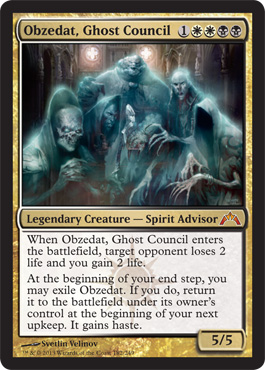
In Depth Spoiler Analysis: Obzedat, Ghost Council and Block Constructed

Hello again, time for some more discussion - this time on how Obzedat, Ghost Council is going to fit into Constructed.  I feel like many people are dismissing this card before really thinking about it.

First of all lets discuss this card alone a bit.  The Ghost Council really is an interesting design, and is not something we have seen much in the past.

Most importantly this is basically a 5/5 for (a very restrictive) 5 mana that cannot usually block.  Keep in mind, that is already really close to playable.  Oh, but it gets better.

I'd like to take the time here to read through this whole ability, since many people have been reading it wrong.

"When Obzedat enters the battlefield, target opponent loses 2 life and you gain 2 life"

So, you're telling me that this guy gets in for 2 AND gets me out of burn range, for free, every turn?  Holy freaking Jesus that's dumb.

Some fun interactions here -
  • This is targeted.  It can be stopped by a Witchbane Orb. 
  • Restoration Angel can get another drain trigger, but only if you main phase the Angel, which might be sub-optimal.
  • This life gain is repeating, making Skullcrack pretty mediocre against it.

"At the beginning of your end step, you may exile Obzedat" - this is a MAY ability.  You can keep him around to block with, if the situation is right.  Even though it will usually be correct to exile him for the 4-point life swing, this will happen.

"If you do, return it to the battlefield under its owner's control at the beginning of your next upkeep.  It gains Haste" - It returns itself only at YOUR upkeep.  Meaning it never needs to be on the battlefield during your opponent's turn.  It is completely immune to any sorcery speed removal.  This is why Obzedat is so insane: It is nearly impossible to kill. Instead of listing all of the cards that don't kill it, let me give you the complete comprehensive list of what DOES kill it.
  • Selesnya Charm
  • Morbid Brimstone Volley
  • Morbin Tragic Slip
  • ... that's it.  Really.


Monday, January 7, 2013

In Depth Spoiler Analysis: Dimir Charm

Hey everyone, it's spoiler season, so it's time again for me to make more prophetic predictions!

Dimir Charm


There have been a huge amount of dissenting opinions on this so far, so I really want to talk about this card.  Since this card is much more situational than the charms that already see a large amount of play in Standard (Selesnya Charm, Azorius Charm), evaluating it is going to be very hard before the whole set is spoiled, and even harder before Standard is fully developed.  Despite the lack of clarity, I can tell you with certainty what we can determine from what we know right now, and I can definitely cover with much more certainty the impact in Modern and Legacy.

So, let's start by going over each of the abilities one by one.


Mode 1: Envelop.  "Counter target sorcery spell"


Here's a list of the Sorceries that we want to counter.


Standard
Rakdos' Return
Bonfire of the Damned
Entreat the Angels
Epic Experiment (Hopefully? :D)
Terminus
Clan Defiance
Farseek (sometimes)
(Lingering Souls purposefully excluded)

Modern
Past in Flames
Scapeshift
Maelstrom Pulse
Thoughtseize/Inquisition of Kozilek (situationally)
Spectral Procession

Legacy
Natural Order
Show and Tell
Infernal Tutor
Burning Wish
Green Sun's Zenith
Glimpse of Nature
Hymn to Tourach
Chain Lightning

My executive summary here?  This mode is not good enough alone to justify main deck inclusion in really any format (yet), but seems really good out of the sideboard, and it could be a huge blowout if you can hit a big X spell.  Envelop is a legal card in Legacy, and most of the time will be better, but in Modern, we don't have any comparable cards.  I really like this mode right now in Modern.

Mode 2: Swat. "Destroy target creature with power two or less"

This is the mode that really puts this card into the playable pile for me.  I'm not even going to list out all of the creatures this kill because it is so long.  This is always going to be active against white and green decks in any format, meaning that viability of this in the main deck is very good.  It also kills important creatures in every matchup in Legacy.

Some fun interactions with this:
  • With Jace, Architect of Thought's +1, you can kill a 3 power creature.
  • On the play it will always kill a mana dork or counter Farseek, meaning it is always good vs. green ramp in any format.
  • In the same vein, this card is way better on the play in Legacy - it kills Delver only on the play (consistently).  It still always kills Dark Confidant, Grim Lavamancer, Stoneforge Mystic, Mother of Runes, Deathrite Shaman... basically every good turn 1 play.
  • Curse of Death's Hold interacts very well with it - you can kill Thragtusk tokens, Garruk tokens...
Mode 3: "look at the top three cards of target player's library, then put one back and the rest into that player's graveyard."

This mode is really bad, and you are never going to want to do this, but there are times when it is important to use this one.  Here are some situations where I would use this mode:

  • Almost always in the control mirror Game 1.  The trend of control decks in Standard is to be strongly focused on instants and planeswalkers, so it is unlikely that there is a card to counter.  If you have Lingering Souls and Think Twice in your deck, most of the time this isn't half bad.  I would, of course, hold the Charm as long as possible to cast for maximum information.
  • When it is the last card in your hand and you are behind on board.  In this situation, any one-for-one trade is not going to help, so digging is fine.
  • When you are very far ahead on cards, but your opponent has a few non-sorcery trumps that can beat you.  An example would be if your opponent has no creatures or cards in hand, 12 lands in play, and Sphinx's Revelation in their deck, while you have 4 cards in hand but no other counters, and you are ahead on board.  Filtering for Negate or Dissipate is strong here.
Conclusions

This charm should be seeing a fair amount of play the very moment the first mode (Counter target Sorcery) is good.  The second mode is always great.  Proper deck construction with this card should ensure that your third mode gets cast as little as possible. 

In Standard currently, we just don't see enough sorceries for this to be a main deck card.  This will probably change in the next few weeks, but for now, this is sitting in the board of my Esper deck against Bonfire.

In Legacy, this card seems to be strong, but generally weaker than other options.  The only deck I always like it against is Elves, since you can't predict which games you need to counter Natural Order and which games you need to kill a Heritage Druid or Nettle Sentinel.  Against Show and Tell and other combo I like Spell Pierce a lot more, and if not that, Envelop has seen play in the past (GerryT played it a few months back at an SCG Open), and it does seem better than this.

In Modern, this card really has potential.  I feel like this deals with so many important cards (Dark Confidant, rarely Tarmogoyf, Deathrite Shaman, Scapeshift, Past in Flames) that it can slot right into the Esper Gifts deck.  There might be another deck for this in the future, hell, it might even spawn a new control deck.  I'd be looking to put this in any deck that needs to improve its game against Black decks.

Thanks for reading, leave a comment if you disagree with anything (and I bet you do!),

Daniel

Friday, December 21, 2012

Modern Elemental Combo, the new budget powerhouse

(Note: It was just pointed out to me that this combo doesn't actually work the way I originally thought.  I will be revising shortly.)

So, Weirfish posted this really cool Modern Elemental combo deck today on Reddit. It looked like this:

Creature (26)

    4x Brighthearth Banneret
    4x Cinder Pyromancer
    4x Flamekin Harbinger
    4x Grinning Ignus
    2x Smokebraider
    4x Soulbright Flamekin
    4x Storm Entity

Sorcery (10)

    2x Fireball
    4x Grapeshot
    2x Ignite Memories
    2x Volcanic Awakening

Artifact (4)

    4x Dragon's Claw

Land (20)

    20x Mountain

This kinda just does everything a depraved casual combo player wants to be doing: Search my library, Play cheap spells, Go Infinite. Here's how the deck works: Step 1: Find a Brighthearth Banneret Step 2: Find a Grinning Ignus Step 3: Find a Cinder Pyromancer, another Brighthearth Banneret, or a Storm spell with enough mana to cast it. Once you have these 3 creatures, you can play Grinning Ignus, then return it to your hand an infinite number of times. If you have two Bannerets in play, then you also net 1 mana per cycle. This will let you win the game through any number of really fun ways, for example Fireball for 4,000,000.

That's cool, but why would I play this?

To be honest, this deck actually looks pretty solid for something that is meant for casual fun. It can even go off on turn 3!

But what would make this into a competitive modern deck? Lets start with the obvious question:

Why would I ever play this instead of Twin or Past in Flames?

Yea, you're right, this deck will never be quite as good as Past In Flames or Splinter Twin. It requires 3 cards to go off, loses to a Lightning Bolt, and has no disruption (at least for now!). But it does have a lot of things going for it that we can look to exploit:
  • It has a tutor that costs 1 mana, finds all of the combo pieces, AND finds the win condition. Hell, we don't even get that in Legacy ANT.
  • It is in a single color, leaving us open to splashing anything, running Blood Moon, and more importantly, making Blood Moon dead against us.
  • Your opponents will instantly tilt when they lose to Flamekin Spitfire.  In Modern.
  • This deck is very fun to play.  But I shouldn't need to say that :)
  • The deck is cheaper than most of the other decks out there.

So, let's make this engine work.

WARNING: This deck is about to get expensive, and crazy hard to play correctly. I'll be making an easier, budget version at the end.

Insert Witty Pun Here

  • 4 Brighthearth Banneret
  • 4 Grinning Ignus
  • 4 Flamekin Harbinger
  • 1 Flamekin Spitfire
  • 4 Grapeshot
  • 3 Faithless Looting
  • 4 Thoughtseize
  • 1 Duress
  • 2 Infernal Tutor
  • 4 Spoils of the Vault
  • 4 Gitaxian Probe
  • 4 Seething Song
  • 4 Manamorphose
  • 4 Blood Crypt
  • 4 Scalding Tarn
  • 4 Arid Mesa
  • 5 Mountain
This is probably far from optimal, but this deck is already VERY good. Let me explain some choices:

Right now in Modern, the hardest to answer win condition for this deck is Grapeshot. We really want to see it every game, in fact, I usually love seeing two. Sadly, the world isn't perfect, so we need Spoils of the Vault. Spoils is a very hard card to play, and many risk-averse players really dislike it, but we don't have a good alternative. It has been calculated a few times that you will lose something like one in every 15 games to it.  I would much rather lose to Spoils than to not being able to find my combo pieces.  When I cast it, I am almost always naming Grapeshot or Banneret.

Manamorphose/Gitaxian Probe: I want to maximize my percentages of drawing my combo pieces naturally, meaning a smaller deck is worth any life payment or vulnerability these incur. Gitaxian Probe also works as a way to know the way is clear against Control. Manamorphose helps us make black mana for Infernal Tutor, which is hard in this deck.

Infernal Tutor: The reason this card is so good in this deck is because it is pretty often that we end up wanting a second copy of something in our hand. We always want 2x Banneret and with many hands, we can go off with this as our last card in hand, to find Grapeshot.

Flamekin Spitfire:  This is for the sweet hands where we have Harbinger, but no win condition.  It sucks to draw sometimes, but isn't dead very often.  I prefer this over Storm Entity because it beats all creature removal (you can put 20 activations on the stack in response to removal).  This does mean that we are incredibly soft to Leyline of Sanctity, but we will have many answers to that post-board.

Let me walk through a sample hand to show how this deck can play.

Flamekin Harbinger, Grinning Ignus, Brighthearth Banneret, Infernal Tutor, Mountain, Mountain, Blood Crypt

This is basically our ideal hand. We are always playing Harbinger turn 1, and we have a choice of finding another Banneret or Flamekin Spitfire. I think the better line of play here is to try to go off Turn 4, finding Spitfire. This is because if our draw step on turn 3 is not Manamorphose, we cannot make the black mana necessary for Infernal Tutor and still go off. My line is this: Turn 1: Harbinger for Spitfire. Turn 2: Infernal tutor, revealing Banneret. Turn 3: Play two Bannerets or an. Turn 4: Make infinite mana, then activate Spitfire 20 times.

So, the budget version?  Glad you asked.

Here is how I would build this given a budget restriction of around $25.
  • 4 Brighthearth Banneret
  • 4 Grinning Ignus
  • 4 Flamekin Harbinger
  • 1 Flamekin Spitfire
  • 4 Grapeshot
  • 4 Faithless Looting
  • 4 Duress
  • 2 Infernal Tutor
  • 4 Spoils of the Vault
  • 4 Gitaxian Probe
  • 4 Seething Song
  • 4 Manamorphose
  • 3 Blood Crypt
  • 4 Blackcleave Cliffs
  • 2 Graven Cairns
  • 4 Sulfurous Springs
  • 4 Mountain
It is arguable that this version is actually better.

I'll see if I can make some MTGO videos of this to see it in action!

Wednesday, April 20, 2011

New Phyrexia cards - Legacy-centric review

Gitaxian Probe and Mental Misstep are the most significant cards in the set for Eternal play.

Also, I just found a clever new Magic pun name for the blog. Sweet.

Mental Misstep

This is going to be a card where which will appear in the 75 (probably as a 4-of) for both Merfolk and Counter-Top. It should also see some play in many other archetypes as a sideboard card, namely in ANT or TES against Spell Snare.

For Counter-Top, it is great against both Merfolk and Goblins, since you would be willing to use your Force of Will on either Goblin Lackey or Aether Vial against either deck. The lack of late-game argument is mostly irrelevant with regards to Counter-Top since a Lackey or Vial is still a very strong card late game against you (though it does depend what version you are running) and most of the cards in your deck are irrelevant once you have the lock in place. I would also like to point out the is counters spell pierce and spell snare, both of which see a strong amount of play and are important in the mirror.

In Merfolk, this card makes the Goblins and Zoo matchups significantly better, because it lets you take the beatdown role. Normally in both of these mathchups, excluding a nut-draw for Merfolk, the game plan is to play lots of dudes to trade and force them to burn your weaker creatures out, then land a leveled Coralhelm Commander or multiple lords in one turn. This is a very difficult plan, and this is why these are Merfolk's worst matchups. With Mental Misstep, you will get to for example, counter Wild Nacatl on the draw instead of Forcing it. This also lets you save your Force for better spells such as Tarmogoyf.

In my list I am testing for Providence, I already have 4 main deck. Merfolk might not being the right deck for that tournament, but if it is, it WILL have 4 of these main.

Gitaxian Probe

This card, while it might not seem that good at first, is WAY better than you think. Why? Because you are comparing it to Peek. Peek generally has only seen play in a few Standard decks (such as Faeries played by Sam Black). What does this go in? COMBO DECKS. Charbelcher, TES, Cephalid Breakfast, probably and non-blue or black Natural Order deck, maybe a Show and Tell deck all might want this card. In ANT you probably don't want it since you really will never be going off before a Duress unless you are 100% sure they don't have it (ie. they played Goblin Lackey or Wild Nacatl). But in TES? TES is much better set up to utilize this card. Not only does it effectively make your deck 56 cards, but it adds to the storm count, lets you know when to play around taxing counters, and even lets you know how long you can wait to go off. Almost every time you will probably rather have Duress, so i'm not saying this is an auto 4-of, but it will probably see some sideboard play against Merfolk and Bant where is it correct a lot of the time to keep hands that only have taxing counters if they have a really fast clock.

The best deck for this card though is Charbelcher. The deck already will sometimes play Street Wraith, and this is a strict upgrade to that. But lets think about this, how does Charbelcher lose games? Basically every loss comes down to having the force for either your Belcher or your last ritual before Empty-ing. For the most part, this card will make game 1 situations where your opponent will not be mulling to Force a bunch easier.

Thanks for reading, and let me know if you agree/disagree!